Friday, September 10, 2010

Group 6: Electron Distribution Mnemonics

members:
Miranda
Magdaraog
Paca
Paculan
Parazo

Electrons tend to arrange themselves around nuclei so that they have the lowest possible energy. They would all like to get into the lowest energy level
The shells are numbered outward from the Nucleus. The maximum number of electrons found in each shell can be calculated by: 2n2.gif (915 bytes) where "n" is the number of the shell.
Shell Number Maximum Number
of Electrons in the Shell
1 2 x 1 = 2
2 2 x 4 = 8
3 2 x 9 = 18
4 2 x 16 = 32
5 2 x 25 = 50


The Octet Rule:
In general, atoms are most stable when they have 8 electrons in their outer-most shell. (Octet means 8.) The exception is the first shell which is most stable with TWO electrons. If you know the Atomic Number and Mass Number of an element and the maximum number of electrons in each electron shell you can draw a diagram of the element.

Each shell is composed of one or more subshells, which are themselves composed of atomic orbitals. For example, the first (K) shell has one subshell, called "1s"; the second (L) shell has two subshells, called "2s" and "2p"; the third shell has "3s", "3p", and "3d"; and so on.[1] The various possible subshells are shown in the following table:
Subshell label ℓ Max electrons Shells containing it Historical name
s 0 2 Every shell sharp
p 1 6 2nd shell and higher principal
d 2 10 3rd shell and higher diffuse
f 3 14 4th shell and higher fundamental
g 4 18 5th shell and higher 

The electron shells are labelled K, L, M, N, O, P, and Q; or 1, 2, 3, 4, 5, 6, and 7; going from innermost shell outwards. Electrons in outer shells have higher average energy and travel farther from the nucleus than those in inner shells.


Energy Levels-   Since an electron in an atom has both mass and motion, it contains two types of energy. By virtue of its motion the electron contains KINETIC ENERGY. Due to its position it also contains POTENTIAL ENERGY. The total energy contained by an electron (kinetic plus potential) is the factor which determines the radius of the electron orbit. In order for an electron to remain in this orbit, it must neither GAIN nor LOSE energy.


Orbital 
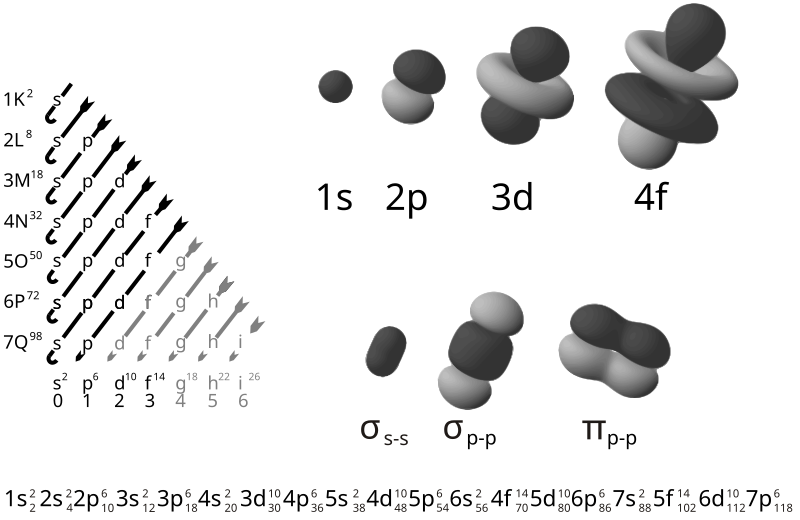
File:Electron orbitals.svg

The orbital occupied by the hydrogen electron is called a 1s orbital. The "1" represents the fact that the orbital is in the energy level closest to the nucleus. The "s" tells you about the shape of the orbital. s orbitals are spherically symmetric around the nucleus - in each case, like a hollow ball made of rather chunky material with the nucleus at its centre.
The orbital on the left is a 2s orbital.This is similar to a 1s orbital except that the region where there is the greatest chance of finding the electron is further from the nucleus - this is an orbital at the second energy level.
If you look carefully, you will notice that there is another region of slightly higher electron density (where the dots are thicker) nearer the nucleus. ("Electron density" is another way of talking about how likely you are to find an electron at a particular place.)
2s (and 3s, 4s, etc) electrons spend some of their time closer to the nucleus than you might expect. The effect of this is to slightly reduce the energy of electrons in s orbitals. The nearer the nucleus the electrons get, the lower their energy.
3s, 4s (etc) orbitals get progressively further from the nucleus.


p orbitals


Not all electrons inhabit s orbitals (in fact, very few electrons live in s orbitals). At the first energy level, the only orbital available to electrons is the 1s orbital, but at the second level, as well as a 2s orbital, there are also orbitals called 2p orbitals.


d and f orbitals


In addition to s and p orbitals, there are two other sets of orbitals which become available for electrons to inhabit at higher energy levels. At the third level, there is a set of five d orbitals (with complicated shapes and names) as well as the 3s and 3p orbitals (3px, 3py, 3pz). At the third level there are a total of nine orbitals altogether.
At the fourth level, as well the 4s and 4p and 4d orbitals there are an additional seven f orbitals - 16 orbitals in all. s, p, d and f orbitals are then available at all higher energy levels as well.


An electron shell may be thought of as an orbit followed by electrons around an atom nucleus. Because each shell can contain only a fixed number of electrons, each shell is associated with a particular range of electron energy, and thus each shell must fill completely before electrons can be added to an outer shell. 

Subshell- Each shell is composed of one or more subshells, which are themselves composed of atomic orbitals. For example, the first (K) shell has one subshell, called "1s"; the second (L) shell has two subshells, called "2s" and "2p"; the third shell has "3s", "3p", and "3d"         
Although it is commonly stated that all the electrons in a shell have the same energy, this is an approximation. However, the electrons in a subshell do have exactly the same level of energy, with later subshells having more energy per electron than earlier ones. This effect is great enough that the energy ranges associated with shells can overlap.


Saturday, August 21, 2010

Group 5 Atoms

Sub-Atomic Particles

>Protons
The proton is a subatomic particle with an electric charge of +1 elementary charge. It is found in the nucleus of each atom, along with neutrons, but is also stable by itself and has a second identity as the hydrogen ion, H+
>Neutrons
The neutron is a subatomic particle with no net electric charge and a mass slightly larger than that of a proton.
>Electrons
The electron is a subatomic particle carrying a negative electric charge. It has no known components or substructure, and therefore is believed to be an elementary particle.
(after dicussung the subatomic particles proceed to Atomic Mass & Atomic #, AZPEN)

Atomic Mass
-                  equal to the sum of the number of protons and neutrons found in the nucleus
 Atomic Number
-                  based on the number of protons and neutron found in the nucleus
-                  Z=protons
Summary of AZPEN:
-                  Atomic Mass= neutrons+protons
-                  Z (Atomic Number)= protons=electrons
-                  Protons = atomic mass- neutrons
      = Atomic Number
-                  Electrons=protons
-                  Neutrons= Atomic mass-Atomic Number

-What are Ions? How do they gain charges? (Provide Illustrations)
An ion is an atom or molecule in which the total number of electrons is not equal to the total number of protons, giving it a net positive or negative electrical charge.
An anion, is an ion with more electrons than protons, giving it a net negative charge (since electrons are negatively charged and protons are positively charged).
Conversely, a cation is an ion with more protons than electrons, giving it a positive charge.
Since the charge on a proton is equal in magnitude to the charge on an electron, the net charge on an ion is equal to the number of protons in the ion minus the number of electrons.

-What are Isotopes? (Give examples & Illustrations)
Isotopes are different types of atoms (nuclides) of the same chemical element, each having a different number of neutrons. In a corresponding manner, isotopes differ in mass number (or number of nucleons) but never in atomic number. The number of protons (the atomic number) is the same because that is what characterizes a chemical element. For example, carbon-12, carbon-13 and carbon-14 are three isotopes of the element carbon with mass numbers 12, 13 and 14, respectively. The atomic number of carbon is 6, so the neutron numbers in these isotopes of carbon are therefore 12−6 = 6, 13−6 = 7, and 14–6 = 8, respectively.

Friday, August 20, 2010

Group 2, MEASUREMENTS

members:
Campanilla
Cinco
Concepcion
Cruz,Gabrielli
Cruz, Jayrene


MEASUREMENT
- defined as a process of comparing an object's physical quantities using a standard measuring device.
- involves numbers accompanied by the appropriate unit of measurement.

UNITS
- identify the physical quantity being measured.

CALLIBRATIONS
- lines and numbers found on measuring instruments
- represent certain place values

ACCURACY
-place value usually represented by the smallest lines on the measuring device
-smallest place value that can be read from the device

ACCURACY AND PRESCISION

ACCURACY
- how close the measurement is to the true value

PRECISION
- how close the measurements are to each other

Wednesday, July 7, 2010

The Plum Pudding or the Rasin Bread Model

Joseph John "J.J." Thomson

J.J. Thomson

Until 1897, scientists believed that atoms were indivisible, but Thomson proved them wrong when he discovered that atoms contained particles known as electrons. Thomson discovered this through his explorations on the properties of cathode rays. British physicist and Nobel laureate. He is credited for the discovery of the electron and of isotopes, and the invention of the mass spectrometer.


Plum Pudding Model

The atom is composed of electrons surrounded by a soup of positive charge to balance the electrons' negative charges, like negatively charged "plums" surrounded by positively charged "pudding. Thomson's model was compared to a British dessert called plum pudding.


Experiment with Cathode Rays


First Experiment
Thomson set out to investigate whether or not he could actually separate the charge from the rays.

Second Experiment
He investigated wether or not the rays could be deflected by an electric field.

Third Experiment
Thomson measured the mass to charge ratio of the cathode rays by measuring how much they were deflected by a magnetic field and how much energy they carried.


source: wikipedia

Members:
Librea
Marco
Medina
Monserrat


DEMOCRITUS

TWO FOUR
GROUP 1
Abesamis
Buenaventura
Castro
Chico


"If you to break a piece of matter in half, and then break it in half again, how many breaks will you have to make before you can break it no further?"


Democritus ("chosen of the people") was an Ancient Greek philosopher born in Abdera, Thrace, Greece. He died ca. 360-370 BC (Aged 90-109)

Era Pre-Socratic philosophy

Region Western Philosophy

School Pre-Socratic philosophy

Main interests metaphysics / mathematics / astronomy

Notable ideas atomism, distant star theory
He was an influential pre-Socratic philosopher who formulated an atomic theory for the cosmos. He has been commonly known as "The Laughing Philosopher". Democritus was nevertheless well-known to his fellow northern-born philosopher Aristotle.

Some scholars believe that Democritus' atomic theory was not really his own. But that of his teacher Leucippus of Miletus.


Democritus proposed the "billiard ball model". The reason behind his proposal is that he wanted to know the solidness of the material corresponded to the shape of the atoms involved. Aristotle modified an earlier theory that matter was made of four elements: Air, Earth, Fire, and Water.


Democritus believed that atoms were small, hard and indivisible particles. And that atoms can be joined, but not broken. He also believed that the interior of an atom is empty.

John Dalton further examined his theory.
hello. ebridabi. gubbay,

Democritus

GROUP 9
Members:
 Uson
 Silang
 Sysantos
 Suk
------------------------

Democritus


Democritus was born at Abdera, Thrace, sometime around 458 BCE. He was described as well traveled, probably visitng Babylon, Egypt, and Ethiopia, and perhaps India. he appears to have spent all of his time on scientific and philosopical studies, teachings, and writing- some 60 works have been listed. Democritus' Theory of the atomic nature of the physcial world, developed from that of Leucippus, is known only through the works of critics of the theory such as Arisitotle and Theoprastus.

He was an influential pre-Socratic philipsopher who formulated the atomic theory for the cosmos.


Democritus' Theory

He hypothesized that all matter is composed of tine indestructable units , called atoms. The atoms itself remains. He also believed that all elements are made up of various imperishable, indivisible elements called Atoms.